
Dateline: October 2025. The Ancient Chinese Empire Is alive and well today. This article will explain modern China through the optics of its historic roots, the ancient Chinese Empire system. This writer studied China at university in the 70’s and never stopped focusing on China ever since. Last June, he got the opportunity to visit China first hand.. The hot reality, the boots-on-the ground Chinese experience, was a shocking contrast to the cool analysis of observation at a distance. Drawing on his experiences (and photos) this article is divided into two sections. Part One provides a socio-political understanding of China in historic context. This understanding can be reduced to the following three-point dialectic: What the hell is going on in China? How did this happen? Is China plain crazy or crazy like a fox?
Part Two of this article is the writer’s travelogue of his China visit. This second section offers support to the ideas present in Part One. The second part presents amusing, but true, stories. The humor is a little leavening to get a rise out of the more dry, academic Part One. Part Two showcases a jarring disconnect between the beauty of China’s historic pageantry, and the day-to-day life of its citizens. Feel free to skip Part One and go straight to Part Two that hopefully has more interesting stories and photos. Part Two is posted separately on this website templesandtribes.net under the title “A Tour of Beautiful China with Eyes Wide Open.” https://templesandtribes.net/a-tour-of-beautiful-china-with-eyes-wide-open/
Part One: Modern China = Ancient China with Better Technology
The ancient Chinese Empire never fell. The Chinese Empire started in 221 BC and continues to this day. The empire has many dynasties including the famous Han, Tang, Ming and Manchu, among many ohters. The Chinese Imperial system continues under the current Communist Dynasty. ruled by the current Emperor, Chinese President Xi Jinping There are two compelling reasons to believe that the current communist regime is best understood as a continuation of the ancient Chinese Empire. Otherwise, the communist center would not hold. China would have collapsed like the Soviet Union, but in accordance with its own circumstances.
First, all of the elements of governance in a Chinese Empire continue unabated under the current communist rulers. China is governed by a unique system drawing largely upon its Imperial heritage. In contrast, a fascist regime or military dictatorship or an emerging socialist state would operate differently than Communist China. There are many, many examples of military dictatorships and authoritarian “strong man” regimes. China does not fit either of these models of governance. These other countries are always stuck in the “middle-income quadrangle” quagmire. In contrast, today’s China follows in the footsteps of Imperial China with new lingo (communist slogans) and upgraded technology. And more importantly, China is on a trajectory that may lead it become the dominant world power.
Secondly, China is a communist state in name only. The socialist slogans provide a thin veneer, a fig leaf barely covering an authoritarian, military-industrial complex the likes of which the world has never seen. Importantly, the entire, sprawling government apparatus is all under civilian control, not a military regime. Under the standard models of development, this country can not exist, and yet it does. Social theory dating back to the Enlightenment tells us that China’s tremendous social stability and economic growth requires conditions that do not exist in China. scope of this artice.
Political Theory Can Not Explain the Meteoric Rise of Modern China
Social theory dictates that a social order that yields a first world economy must also develop a long list of social preconditions, economic structures and civic institutions. Underlying a lot of these components is that requirement that citizens must have a certain amount of free choice. That is, a country can not develop a flourishing economy in a regime based on political repression and social fear. People in the top economies must have certain amount liberties that we commonly take for granted in the West. Society must be nurtured through the rights of speak openly,, freedom of worship, the lifting of arbitrary restrictions; on, freedom from political coercion, the right of individual choice, association, education work, and travel.
In contrast, China is an officially atheistic country that gives its citizens precious few individual rights. China meters out maximum social control over a person’s thoughts, actions and associations. The consequences for individuals violating the rigid social controls range from petty sanctions to extreme punishment. The government wields sticks that include confiscation, fines, ostracism, social shaming, loss of job, restrictions on he right to travel, arbitrary arrest, forced labor camps, “re-education”, or worse. These severe restrictions on the individual level are mirrored on the macro economic level. China does not have the essential preconditions required for a flourishing economy and an accumulation of capital. These pre-requisites include a rule of law, uniform enforcement of existing law, a fully articulated right to contract, economic freedom, plus well developed contract and commercial law. Other common government structures embedded in world-class economies include independent branches of government, an independent central bank and a judicial system free from political or financial coercion. In addition, China does not have well established civic, social and charitable organizations with deep roots in the community. Civic organizations owned and operated by the Chinese Communist Party for the benefit of party members but the benefits do radiate out somewhat to the broader population. In recent decades, there has been progress in the development of some of these prerequisites, but not all. However, many of the key prerequisites remain minimal or stunted at best. At best, the Chinese rulers are building the airplane as they are flying it. However, they are also leapfrogging over western social theory and developing a new, Sino path to world domination.
Using this standard analysis, China can never develop a world-class economy and military. Okay, but how do social scientists explain away China’s growing power? The last redoubt of standard economic theory — the dying swan song of western nah-sayers — is the emerging sputterance of “Peak China.” The “peak China” rallying cry trumpets that China, in spite of all of its internal contradictions, has had a good run. However, the race is over. China has risen to the highest levels that it can achieve. China, like a fat man running downhill on gravel, is on the downhill slide. China has peaked, is about to plateau and later will likely plunge into an economic and social morass. “Why Nations Fail” by Acemoglu and Robinson, chs. 12 and 15. See for example, Peak China may be wishful thinking on the part of China’s detractors. However, this writer, Zephyr Carlyle, likes this concept. This writer’s has advancing age with the normal decay in his physical condition. Yet, this writer is still at his top functionality with full life enjoyment. He is at “peak Carlyle” right now. The inevitable decline is coming at some point when he slides down from the summit.
Communist China as a Continuation of the Ancient Empire is Not a Laughing Matter
According to the history books, the Chinese Empire started with the Qin Dynasty in 232 B.C. and ended in 1911 with the overthrow of the Manchu (Quing) Dynasty. Other Chinese dynasties before the Manchu fell which lead to periods of uncertainty, competing regional empires or civil wars. Afterwards, the country and government reunited with a new, unified dynastic order. This periodic pattern of an unstable interregnum and dynastic re-establishment is exactly what happened after the fall of the Manchus. There was a great period post-revolutionary instability after 1911 overthrow of the Manchu Dynasty. China then plunged headlong into catacylmic battle. China first had to repell foreign invaders, the Japanese in WWII; and later, fought out an internal civil war. In 1949, out of this maelstrom emerged a new Dynasty that eventually unifidd all of China: the Communist Dynasty under Mao Tse Tung and his successors. Only the small island of Taiwan was able to stay out of the control of Mao and the communists. The main thesis of this article is the continuation of the ancient imperial system is the main pillar of China’s current growth and stability. Before you dismiss this idea as a joke or the writer as a crack-pot, review the article. Then you will have all the information to decide.
General Background on the Rise and Fall of Civilizations
FEEL FREE TO SKIP THE GENERAL BACKGROUND SECTION ENTIRELY
Some ancient empire end at a given date. The Egyptian empire ended famously with the suicide of Queen Cleopatra VI on August 30, 30 BC.The Persian Empire ended in 330 BC when Emperor Darius III was defeated in several battles with Alexander the Great. Other imperial dynasties, such as the Roman Empire, fall off a precipice but clung to a tree branch on the way down to suffer a slow, painful demise.. The death of Roman Empire has been pegged to three different dates: the history buffs favorite date is 410 AD (the Goth sacking of Rome); the returning champion date is 476 AD (collapse of the Western Roman Empire; and the perennial runner-up is 1453 AD (the fall of the Eastern Roman Empire, also called Byzantium)
Thus, when the Roman Empire ended is a movable target. There are also an ….. ummm, historians attempting to be light-heartedness — or perhaps there is a conspiracy theory — that proclaims the Ancient Rome never fell. The Empire still exists. Evidence includes an old Star Trek television show. In the episode, “Bread and Circuses”, the crew of the starship Enterprise are captured when they discover a parallel reality where the Roman Empire never collapsed. Instead, the ancient Romans advanced to a 20th-century level of technology. For example, as the episode title suggests, Roman citizens are entertained by televised gladiatorial combat to the death.
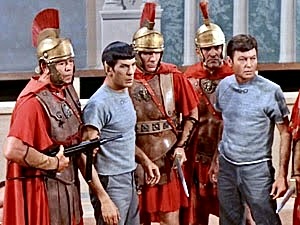
Above: First Officer Mr. Spock and Dr. Leonard “Bones” McCoy from the ‘60’s Star Trek TV show.
Poppycock! Okay, let’s take it down a notch. The Star Trek story is probably not true. But just use your creative imagination. Imagine a world where the Egyptian Pharaohs still rule from the Nile delta and all of Egypt follow the dictates laid down by their Gods — Osirus, Isis (the Egyptian equivalent of the Greek Zeus and Hera) and other deities. Perhaps the successors of Nebuchadnezzar II still rule in Bablyon (Iraq.) The Babylonian Emperor promoted the worship of the Babylonian pantheon, with Marduk as the national god, However, Nebuchadnezzar eventually came to acknowledge the God of Israel after witnessing the Biblical prophet Daniel and the faith of Shadrach, Meshach, and Abednego. What would the Middle East look like today if the Babylonian empire survived?
The Chinese Empire Made it to the 21st Century
All the above mental play toys are the stuff of historian’s whimsy and laughable propositions. Until you get to China where this story line becomes real. Not a fantasy but In fact, the Chinese Empire never fell. Rather, the Chinese Empire shifted, with some minor tweaking, into its curent ruling form: the Communist Dynasty. The essential ellements of the Chinese Empire Communist China are the same. The Communists have upgraded and imported the Chinese Empire into the 21st Century. Don’t take this writer’s fanciful notions on the topic. Let Google AI ferret out the the needed background information: What are the basic elements of the Chinese Empire? Google Al’s answer:
“The fundamental elements of the Chinese empire included its hierarchical and paternalistic bureaucratic government, grounded in Confucian philosophy and emphasizing rule by moral example. Key aspects were its autocratic monarchy with the emperor as “father of the people,” a complex system of central and local administrations, and a highly developed official selection process. Other integral elements were the cultivation of an advanced agrarian and industrial economy, the organization of a powerful military, and the pervasive influence of Confucian social order that structured both family and state. ”
In the above quote, take out the word “Confucian” and insert the word “Communist.” There, the quote now describes the workings of Communist China in spades. The Confucian traditions melded with the pragmatic ideology and actions of the current communist rulers This combination has spawned a new society that is moving fast to create a self-proclaimed, new world order.
What Do Chinese Emperors and Communist Dictators Have In Common?
This same question from a broader perspective is: How can Communism and Confucianism be so closely aligned? Easy, from their core values to to the periphery of their beliefs, communism and Confucianism are in agreement. They both have the same views on society and government and the individual. Here are some of the common key elements.
Atheism — Communism is famous for espousing that there is no God. Perhaps surprisingly, the Confucianism of Ancient China was largely atheistic also. Confucianism is not a religion. It is an ethical and moral system that has no God and no need for any deities. One support for this atheism is that Confucianism draws on the earlier Taoists beliefs. In Taoism, core concept, the Tao, is an impersonal, universal force and not a deity. Yet, both Confucianism and Taoism do include worshiping sacred ancestors and honoring special teachers. So does communism, which reveres sacred ancestors such as Marx, Lenin and Mao; and others such as Sun Yat Sen who led the overthrow of the prior Qing Chinese Dynasty in 1911 .At least officially, China still honors all the valiant communist heroes who can still teach us today by their example. These local heroes cover the communist gamut ranging from the survivors of the infamous Long March (1934) and Lei Feng. Admiration, or maybe adoration, of Mao Tse Tung and Lei Feng are as close as communist China gets to worshiping deities. The Communist worker-hero, Lei Feng, also serves as a poster boy for Confucian ideals:
Lei Feng (1940 – 1962), born Lei Zhengxing, was a soldier in the People’s Liberation Army who was the object of several major propaganda campaigns in China. The most well-known of these campaigns in 1963 promoted the slogan “Follow the examples of Comrade Lei Feng.”[1] Lei was portrayed as a model citizen, and the masses were encouraged to emulate his selflessness, modesty, and devotion to Mao Zedong. In the following years, Lei Feng was portrayed as a symbol and model of party revolution by both the Chinese Communist Party and Government of China. For decades, he promoted the “Learn from Lei Feng as a Model” in the media. (Wikipedia)
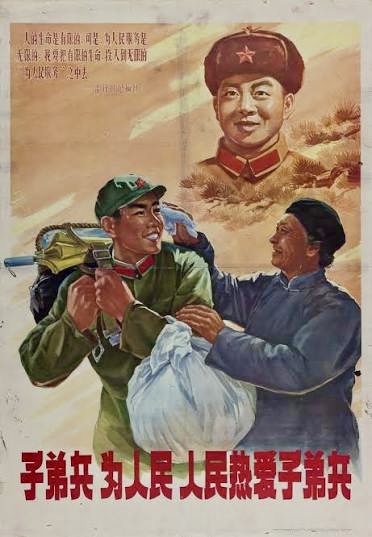
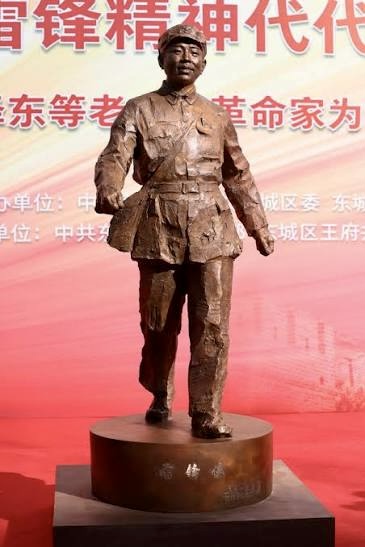
Above: The Adoration of Lei Feng
Role of Authoritarian Leader – The leadership of both Communist and Confucist Dynasties gravitate towards centralized power in one key benevolent-appearing leader. These leaders can be ruthless, and they can be extremely powerful; but they do not rule absolutely on their own, solo authority. First, both Confucist and Communist leaders rule paternalistic systems genuinely helping — or trying to help — the bulk of the population. In both systems, the leaders rule with the support and guidance of a group of advisors and experts, many of whom have an independent power base. Not only the powerful clique of advisors systems but several other factors shape the scope to the leaders power. In one example, Ffor many years before Xi Jinping eclipsed all other authorities and became the new emperor, supreme power rotated among members of the Standing Committee in according to preset rules. Modern day military dictatorships and authoritarian regimes do no such thing.
he Emphasis on Achievement and Merit in Governance — In China, both communist and Confucian dynasties are meritocracies. Confucian governance is renowned for it’s reliance on extensive education, training, and examination. A merit based system regulated work in all levels of government and industry. Modern China has burnished the Confucius system of education and exam for success in school, private industries and government service — all merit-based placement. Surely, there is a small amount of cronyism and back-scratching. Yet, to their credit, the communist system is a merit system and that reverberates throughout the society and yields numerous benefits for all,
The Scope of Governmental Authority. In another example, both ancient China and modern communists require benevolent dictatorships. The focus of the government must be on promoting the well being of the people if it wants to continue to govern. As set out in Part Two , in China today the economy is booming lifting the wealth and well being of broad sectors of the economy. Millions of millions of China’s poor are being lifted out of poverty. The struggllng middle class have finally gotten a foothold on solid financial success. Similar tangible success is evident t in social programs. The Chinese government has promoted a vast array of social welfare programs ranging from free health care, education, industrial training, public health including extensive wellness and fitness programs.
Drawing on Buddhist beliefs that dovetailed Confucian tradition, the Emperor’s power was entrusted to him through a “Heavenly Mandate” from the Gods above. The easy interpretation of this heavenly directive is that God gave the absolute mandate of power to the emperor. The emperor could rule absolutely in perpetuity. No. There is a check on this static idea of Heavenly Mandate. This limitation is embodied in an oft-repeated, universal Chinese refrain every Chinaman knows in his bones: “The Heavens see as the people see.” Thus, if the people see differently, if the people rise up en masse, the emperor is finished, whether Confucian or communist. In this case, the leadership has lost it’s mandate and lost the authority to govern. Why the people today seem to accept China’s severe authoritarian system would require extensive review. However, one key to social stability is the deference to power and filial piety intrinsic to the Confucist world-view. The Chinese communists are inheritors of a Confucist-Taoist and Buddhist social system that creates a bedrock for their social stablity.
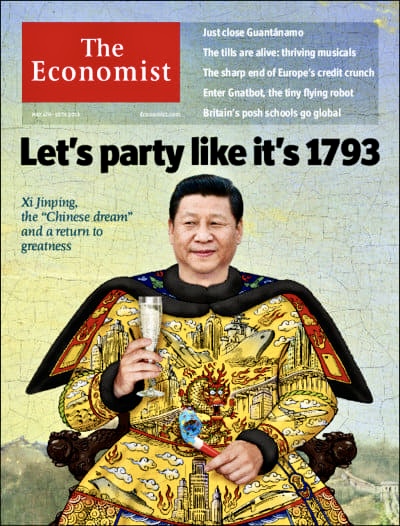
Left: Chinese President Xi Jinping. Many, including The Economist magazine see Xi Jinping as the latest in a long line of Chinese Emperors. In the current Communist Dynasty, Emperor Mao Tse Tung was given the Mandate from Heaven. This mandate has allowed the communists to rule since 1949. Perhaps the “mandate” for are the universal, inexorable principles, the Communist March of History to the better, egalitarian future. In any case, Marxist-Leninist ideals have the same effect and ethos of a divine mandate. The fact that Communist China has veered away from Marxist economic policy is a long story, to be told another time.
In sum, these Imperial elements augur the continuation an ancient, authoritarian regime with benevolent, uplifitng programs. The communist elite maintain their system through a coterie of close-knit advisors, emphasis on merit, and a strong chain of command. But the communist overlords are always mindful of people’s ultimate authority. This system does not exist in other authoritarian governments now, or in history. Compare the Chinese system of governance with, for example, Louis the IXV of France in the 18th century, Shah Riza Pahlavi of 20th century Iran or even Vladimir Putin of modern Russia — or go for the obvious comparisons such as Hitler and Stalin — or any of the dozens of other regimes that rose up and then fell. Will China as the inheritor of the Imperial system follow this pattern? Maybe China will collapse under its own weight, combined with foreign power struggles? Or, will unique China break the mold to become the number one world power? If this writer were at a gambling den in Macau, he would not bet against China.
Illuminating! I worked with several Chinese engineers and one is a close friend. None ever had anything positive to say about the Chinese government. I did not know that the Egyptian empire expired with Cleopatra. I will look for that Star Trek episode. Such a great series!