[Note: this article was really written in August, 2025] Dateline: The Holy Land, 800 B.C. The 9th B.C. prophet, Isaiah, reported in the Bible about the enchantment of Ethiopia, giving it an allure that continues to this day. The prophet described this magical land in Isaiah 18: 1-7. He wrote that: “You can go further, even “beyond the rivers of Ethiopia” where the sound of wings is heard, and ambassadors come down the Nile in reed boats.” Isaiah goes on and foretold of a time when Ethiopians will bring gifts to the King of Kings, the Christ. Isaiah is only one of many that declaimed Ethiopia pivotal role in many religious and historic traditions. Ethiopia, the ancient land of Queen Sheba, also has centuries of Jewish heritage; the Three Wise Men; and an ancient, charismatic Christian church still thriving today. Ethiopia knows a lot about the Divine in all its radiant forms and representatives. Even today, just like in the 8th century before Christ, visiting Ethiopia is a powerful, moving experience. Yet, many other countries also have their siren call. Perhaps you are a traveler trying to choose among the many countries that tickle your fancy. With so many global choices, let’s say that you are only going to get to only one African country. But which African country is the best? To help you decide, this article will review the many choices that showcase the African experience.
[Introduction to the Universe of Africa. Feel Free to Skip This Three Paragraph Intro Section — Dive Right Into the Part on Ethiopia]
Africa is not the first choice of most travelers. Indeed, the travel universe revolves around Southeast Asia, an easy conclusion based on the following impromptu experiment, repeated endlessly all over the world all over the world. Travelers are often randomly tossed together into small groups as they scurry from one tourist trap to another. These travelers, strangers to each other, may wind up sitting at the same bar table; waiting together for a bus; or are thrown together by assigned dining seats on a cruise. Cheery travelers will make the best of their new, unplanned travel mates. They share camaraderie by regaling each other with tall travel tales. The travel talk will inevitably devolve to the least common travel denominator: Southeast Asia. The conversation will be peppered with Indo-Pacific gems and insights such as: the best islands off the Vietnamese coast, the inside track on the local bars in Bangkok, how to avoid a bum elephant ride in Cambodia, and the places that people in the know go; like that hush-hush, secret, trendy destination: Laos. Of course, there are the required polite brawls around that perennial conundrum: Which is better, Bali or Phuket? And who has the best frog legs?
Now when you add this writer into this equation, the conversation dynamics change. When I am with these spontaneous focus groups, I would always sit silently. I would listento the rich exchange of the one-upmanships and glib showing off. Eventually, someone will turn to me: “Say, where have you been in Southeast Asia?.” Years ago, I would answer: “Nowhere. I am an Africanist. My specialty is traveling through Africa.” The group response was the invariable dead silence. Finally, someone would chime in, “Well, I went on a day trip to Morroco as part of my tour of southern Spain.” Someone else will inevitably contribute, “Oh, I can do better than that. I spent a week in South Africa. I stopped by on the way back home from my last visit to Singapore.” Often the group conversation ended right there. I was a wet sponge dampening those sizzling conversations a long, long time ago. Nowadays, I can add sizzle to a conversation as well any Asiaphile. I have lived in Indonesia for many years and traveled throughout Southeast Asia.. I can finally provide the answer to that burning question: “Bali, Indonesia is definitely better than Phuket, Thailand.”

And Cambodia has the best frog legs.
In the 21st Century, Travel Is Easy and the Top Feeders Rule: The world is awash with top feeders; that is, travelers who, like sharks, never stop moving. Top feeders skim across the surface is the earth gobbling up the world’s experiences, miles and meals as they swim from horizon to horizon. In sum, there is a huge chunk of people who wander across the earth’s 24 time zones. These top feeders include digital nomads, intrepid tourists, modern gypsies, unmoored retirees, trust funders, experience junkies, and even impoverished backpackers. This last group is called begpackers, so named for how they make their travel money. In contrast, people rooted in the real world, the world where people stayed moored in one place, these normal folks feel luck. Why? Because they got to go to Europe — twice!. But among the globe trotting topfeeders, there are many common experiences and shared connections even among those who cruise distant parts of the world. I have sat in on many conversations among groups of travellers all randomly thrown together;, strangers who all meet by coincidence in some bar, cruise ships, railway stations waiting room, or the like.When the travel-weary start chatting amiably, the conversation will always focus on their voyages. The desultory conversation quickly settles on the one universal topic that is always a crowd pleaser: SouthEast Asia, the Mecca of global travel. People will ejaculate information and get animated swapping tall tales of SouthEast Asa: What islands off of the Vietnam coast have the inside track, the best elephant rides in Cambodia, memorable street food in Singapore, traveling by motorbike throughout Vietnam, and why people “in the know” are hoofing it to Laos. Invariably, the group will grapple with the Big Question: Which is better, Bali or Phuket? And which country has the best front legs?
But Focus on Africa: Never mind about the Southeast Asia groupies. Putting aside the Asian fanboys, there remains a relatively small but ardent number of people who love to be in Africa. These Africanists are a hardy bunch, and very opinionated. But they can help us figure out what is the best country in Africa to visit by using this thought experiment. First, appoint the leader of the African Union as the Neutral Arbiter who makes the final decision. Then, set up an African focus group. Put in the same room a big bunch of people who have travelled extensively in Africa. Then, pull the pin and throw this question grenade into the crowd: “What country is the best place in African to visit?.” Quick, step back to avoid the explosion. You will hear the concussions of love by the West African anthro lovers. The ringing declarations of the Bantu boys will ricochet around the room. Eventually the Bantu Boys trumpeting will collide with the exclamations of joy from the East African chill surfers and beach combers. And everyone has to confront the finger-jabbing travel sailors who heard the siren call of North African, with that famous Morracan hospitality. Then pops up the Southern African safari crowd who bellow loud and clear about the glory of the veldt. They will not accept a second place trophy in the hunt for the best place in Africa! Finally, advocates from every corner of Africa jumps into the scrums and triumphs their favorite locale. To avoid out-and-out bloodshed, the Neutral Arbiter, ends this frank exchange of views. The Neutral Arbiter announces that he will consider all the opinions expressed. He will ponder this question and then decide which African country is best. Everyone goes back home to their native grassland, river bank, rain forest, mountain side, wind swept desert, or beach front bungalow. In the middle of a restless night, the Neutral Arbiter bolts upright in bed. Hurrying downstairs, he stops and gingerly open. the front door. The Arbiter sticks his head out and whispers: “It’s Ethiopia. That is the best country to visit. Ethiopia.” And here are the Neutral Arbiter’s reasons why:
Ethiopia Was There at the Beginning of Human History
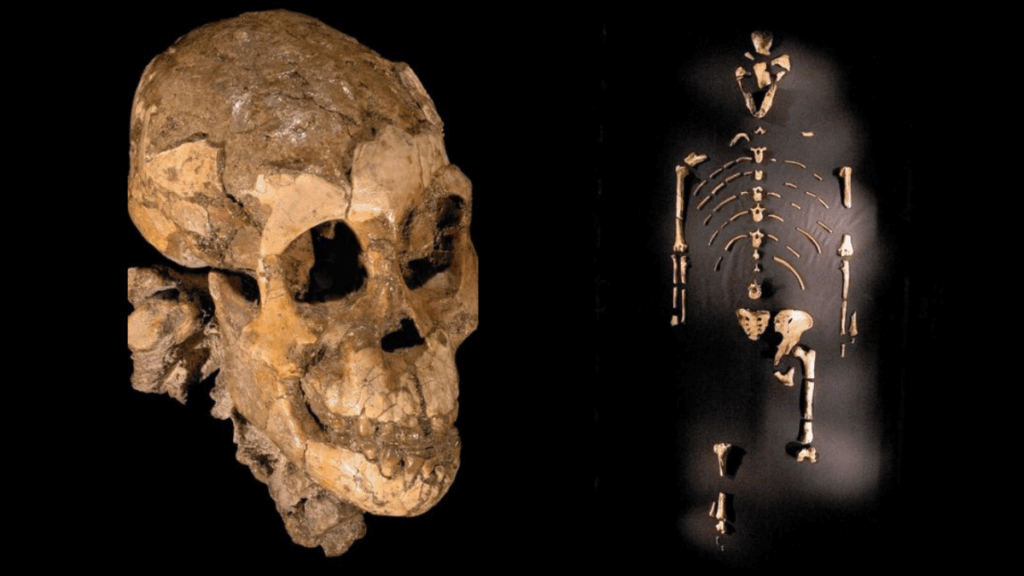
Ethiopis is a multi-dimansional tapestry that warps the human imagination. The problem is that the Ethiopian tapestry is so complex that the carpet may unravel in the telling. Yet, it is always best to start at the beginning. Ethiopia looms large throughout human history, starting with the formation of mankind. Ethiopia has the key to human life in the form of a skeleton named Lucy. The hominid is the oldest known member of the earliest human animal, the Autralopithecus afarensis. She was discovered in Hadar, Ethiopia, in 1974. According to Nature maganine, Lucy is estimated to be about 3.2 million years old. Lucy’s discovery revolutionized our understanding of human evolution, demonstrating that early hominins walked upright and lived in Africa millions of years ago. https://www.nature.com/scitable/knowledge/library/lucy-a-marvelous-specimen-135716086. Lucy did indeed walk upright and her descendants walked right out of Africa. These early humans are the primogenitor of us all in the year 2025. Here is the skeleton of Lucy, which is 40% complete, including her skull:
The Abyssinian Empire of Ethiopia had a Jewish Heyday for Eight Hundred Years
Going back to the early Ethiopian hominids of the Lucy’s people is a fool’s errand. We get lost in the mist of time. Better to focus only on full human civilizations — like times where historic records survive. Ethiopia is still front and center of early Human Civilization. Ethiopia was the home base of the far-flung Axum and Abyssinian Empires. Over the centuries the earlier Axum Empire expanded and contracted in size and scope. However, Abyssinia was at its zenith after the long-duration period of the Axumite decline. The Axum Empire started around the time of Christ and later evolved into Abbyssinian Empire, which lasted from 1270 to 1974. However, both empires were headquartered in the sacred city of Axum. Basically, Abyssinia and the Axumite Kingdoms are rouglhly synonymous. Abyssinia is more famous of the two empires. For example, only Abyssinia is referenced several times in the Bible.
During early Hebraic times, the general Abbysinia area, then still under the command of the Axumites, controlled a huge swath of southernly land, adjacent to the Middle East. Shortly after Abraham established the Jewish faith, The Ethiopians were early in line to sign up for the Hebrew program. But to make this transition complete required the celebrated and enchanting Queen Sheba, the Empress of Axum and all of Abyssinia. Sheba lead all of her people to Judaism after her fantastic sojourn to Jerusalem. Sheba had heard so much about the wisdom and piety of the early Hebrew King, Solomon. the Queen had to find out more in person. With a great entourage and a two-year journey, Sheba traveled from Axum to Jerusalem. She and Solomon were mutually enchanted. Sheba stayed with the Hebrew King for two years. At the end of this time, she regrettably had to return to her native Ethiopia but left with an unexpected present from Solomon. Unknown when she disembarked from Jerusalem, Sheba was pregnant with King Solomon’s child. According the Ethiopian tradition, Sheba gave birth to a potential heir to the Jewish throne, her son King Menelik I. He grew up to become one of the most heralded and successful Kings of Abyssinia.
While In Jerusalem, Sheba converted to Judiasm. On her pilgrimage back to the Abyssinian capital of Axum, she extolled the virtues of Judaism to all of her subjects. Thus, Axum Empire and the greater Abyssinia became a Jewish state. And again, Ethiopia may be the linchpin of civilization. When Sheba left Jerusalem, she carried two surprises: both the newly conceived child of Solomon and the Ark of the Covenant. According to traditional lore, Soloman secretly sent the Ark to Axum for safekeeping as that was troubled times in Jerusalem’s history with serious risks of Roman invasions. Solomon did not even tell Sheba she was carrying the Ark until her caravan had safely travelled away from at-risk areas. The Ethiopian church has safeguarded the Ark ever since. The modern Ethiopian Orthodox Church, with the full throated support of the locals. proclaim that Ethiopia still has the much-sought-after Ark of the Covenant, The Ark is most holy of the holy sacred texts of Judiasm The Ethiopian Orthodox Church claims it is in the Church of Our Lady Mary of Zion in Axum, Ethiopia. See below for details about the Ark. Now, both these tall tales about the two secrets carried away by Sheba may be exaggerated details. However, the factual claims have some historic support: Perhaps it is true that Menelik I was Solomon’s son. The Ark could very well be in Ethiopia to this day. If anybody else has the Ark, they are not talking.
Centuries later, Ethiopia converted to Christianity. However, pockets of Jewish populations resisted Christianity, especially in rural areas. These isolated communities became the Falashas. The Falasha Jewish traditions became degraded over time and integrated into more traditional rural practices. Yet, at their heart, the Falashas follow the Jewish faith and practices, including the use of a proto-Hebrew language. Modern day Falashas practice a crypto-Hebraic religion still rooted in Jewish traditions. Yes, the Falashas are still Jews. The Grand Rabbi of Israel recognizes the Falashas as full Jews. Therefore, they are free to return home to Israel as are any other Jews world-wide. In fact, in recent decades, most of them have emigrated to Israel freely under the Jewish Law of Return.
The Axumite Empire Raced for the Christian Embrace, Early and Often
Ethiopia has a staggering history — literally staggered in layers. The Solomonic-Sheban Jewish heritage lasted for about eight hundred years. However, in the 4th century A.D. Ethiopia officially adopted Christianity during the zenith of the Axumite Empire. The entire Axum Empire converted to Christianity under the guidance of the fervid Christian convert, the Axumite king of that time. Ethiopia was one of the earliest regions in the world to embrace the Christian faith. Yet, Ethiopia has even an older claim on Christianity. Going back further in time, Ethiopia was front and center on the birth of Christianity, even before the mass conversion of the 4th century.
Ethiopia has a long reach into the Christian History. Ethiopia was present at the very inciption of Christianity: The birth of Christ. Remember the three Wise Men of the Orient who witnessed the birth of Jesus? Back then, “the Orient” refered or Abyssinia or perhaps the lands just beyond Ethiopia. Thus, all the three Wise Men may well have been Ethiopians. However, for sure, at least one of the Wise Man was Ethiopian, the so-called Black King. Look at depiction of the Wise Men and one will be a Black African among them. Clearly the Ethiopian Wise Man was Balthasar, and he brought the gift of frankincense.
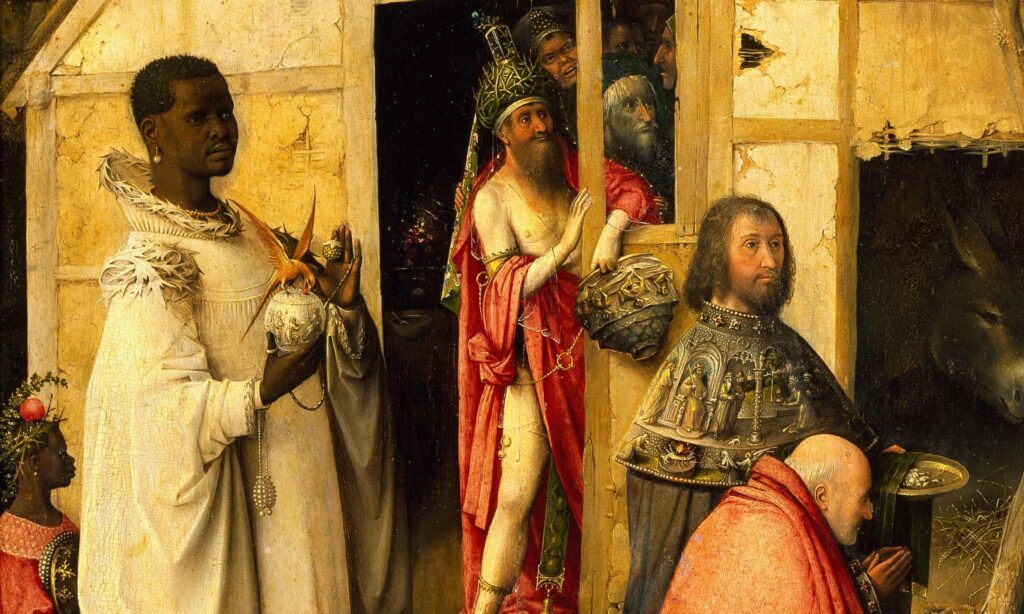
Above: Balthasar in a detail from The Adoration of the Magi, 1510, by Hieronymus Bosch. Photograph: DEA/G Dagli Orti/De Agostini/Getty Images. Bosch himself could not attest that Balthasar was African but he followed that traditional depiction.
Today, the vast majority of Ethiopian in urban areas are fervent Christians with an ardor similar to the ardor of USA Evangelical Christians (but without attempts to convert outsiders to their religion). There are Islamic mosques and residents in Muslim attire in all of Ethiopia but they are in the background of most cities and towns. Yet, surprisingly, with the seemingly broad-based support for Christianity, the Ethiopian population has only a small plurality of Christians overall, about 43%. Muslims make up about 40%. The rest of the populatin are animists, some traditional religions, or remnants of the Falasha, the crypto-Jewish community.
Fast Forward to Modern Times — The Two Great Emperors of the Colonial Era
A reference to the colonial era in Ethiopia is a misnomer. Ethiopia was never colonized by Europeans. Africa has fifty four countries today and only two nations escaped European conquest. Ethiopia is one of the two. Liberia is the other African country never colonized
Menelik II. Why was Ethiopia never colonized? One main reason Ethiopia escaped the imperial yoke was thanks to the fierceness of Ethiopian warriors. During the critical times, the Ethiopian warriors were under the command of the genius military commander and leader, Menelik II. The modern day Menelik the Second is the direct descendant of Menelik the First, a thousand years before, that primogeniture son of Sheba. Following in the greatness of his forebearers, Menelik II Is the ONLY Africa leader to completely defeat an European army on the battlefield. Italy attempted ot colonize Ethiopia but was soundly crushed in the Battle of Adowa in 1896. Ethiopia kicked some Italian ass in that war and booted Italy out of the country. Ethiopia remained free. Decades later, Mussuline tried to re-invade Ethopia to assuage old wounds. The Italian army gained a foothold in Ethiopia, but could not conquer the kingdom. After about a year of tense warfare in the 1930’s, Italy was again forced to retreat.
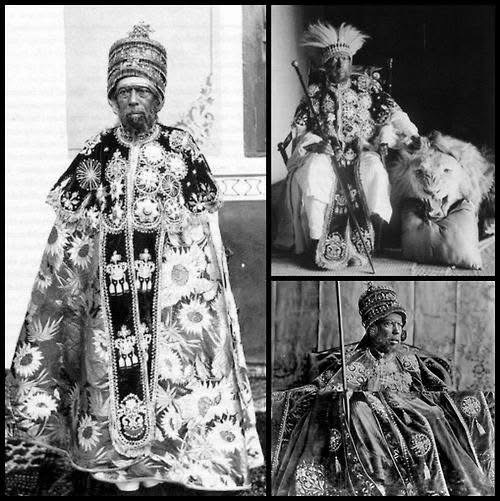
Left: Menelik II was born on August 17, 1844, and died on December 12, 1913. He ruled as King of Shewa from 1866 to 1889, and then as Emperor of Ethiopia from 1889 until his death. Do not ask me about the lion. I do not know.
Haile Selassie – There is no modern monarch with a story more poignant than the tale of Emperor Haile Selassie, truly a great man. Selassie was a youth who assumed the Ethiopian throne in shaky circumstances in 1906. Yet, he went on to assume the mantel and title of “The Lion King of Judah and Ethiopia.” Note: Judah is a reference to the Kingdom of Judah, the land of the Jews. Yes, Selassie was the successor of the great Hebraic, Axum Empire going back to the Queen Sheba herself. See below for details all of these topics. Yes, Selassie lived in opulence, but not excessive for a magnate of his stature. He ruled with benevolence and labored mightily to improve the lives of his subjects. He used his imperial powers to focus on upgrading Ethiopia into the 21st century. Selassie successfully led his country thorough both World War I and World War II. including notably defeating Mussolini’s invading army, However, Selassie’s enduring legacy is, oddly enough, in the area of world music, specifically reggae. As mentioned, Emperor Selassie was the Lion King of Judah. To this day, his followers consider Selassie a Divine Presence. The worldwide movement of Rastafarians — famous for reggae music — actually worshop Selassie as God on Earth. The worship of Haile Sellassie is the central core of Rastafarian beliefs or religion. For those who need proof about the basis of Rastafarian faith here it is: Haile Selassie’s actual name is Ras Tafari Makonnen. Many in the whole reggae movement, from Bob Marley on downward worship Haile Selassie as God.
Sadly, Selassie had a tragic ending. He was trying to be the benevolent, but absolute, Abyssinian Emperor, after the time for ancient autocrats had passed. Ultimately in 1974, Selassie was deposed in a military-led, Marxist-inspired coup. The revolution was spearheaded by the horrific Miriam Haile Mengistu, leader of the Durge movement. Ethiopia suffered terribly under the rule of the Durge for thirteen years, none worse than Selassie himself The Emperor was put under house arrest by Mengistu in 1974, shortly after the coup.. A year later, Selassie, at age 83, the Durge killed Selassie in his palace. The Abyssinian Empire started in 1270 and continued to the modern era. The empire finally ended in 1974 with the coup against Abyssinian Emperor Selassie, and his subsequent murder.
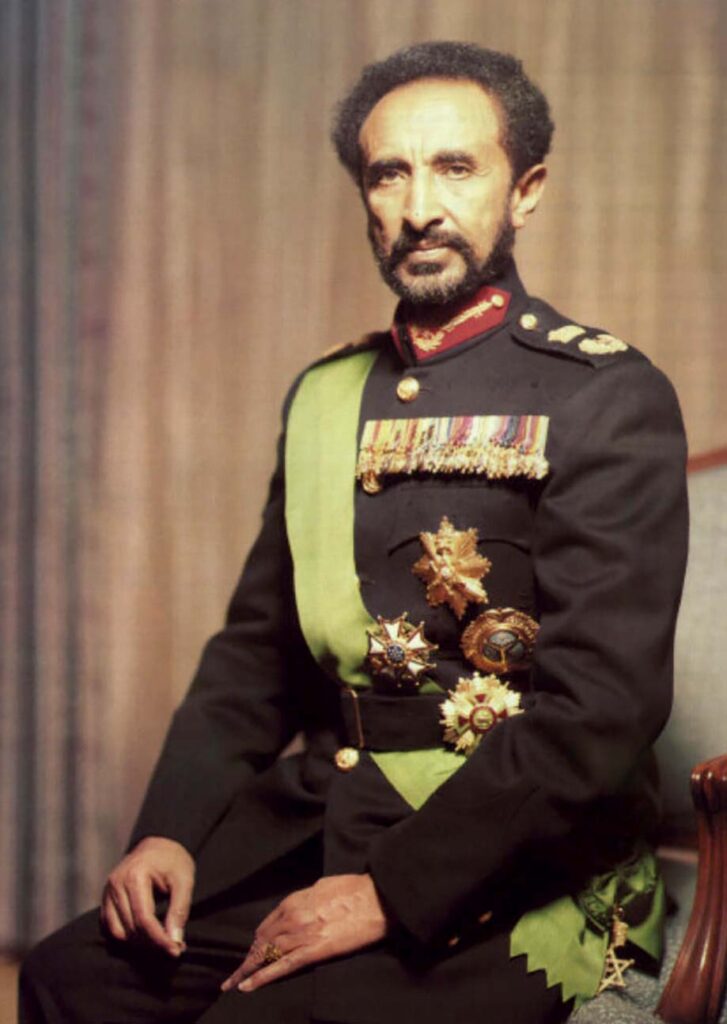
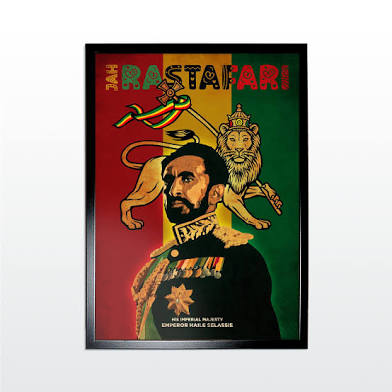
Left: Haile Salassie in full emperor regalia in 1963. Above: The Emperor was the center of the Rastafarian movement and religion during his lifetime, and the adoration continues until the present time.. The early years: Haile Selassie I born in July 1892. He rose to power as the Regent Plenipotentiary of Ethiopia (Enderase) under Empress Zewditu between 1916 and 1930. He ruled as Emperor of Ethiopia from 1930 to 1974. Emperor Selassie died in 1975.
Travelers Dilemma: What to See and Do In Ethiopia?
I can list all the things to see and do in Ehtiopia — how much time do you have? To make things easy, Ethiopia excels in three main areas of tourist interest: 1.) Ancient history including archeology, ancient civilizations and temples 2.) cultures and tribes, modern and traditional 3.) wildlife and nature, especially birds. All of these broad topic areas are connected through the history of Ethiopia. The art, religions, geography, envioromnent, civilizations and peoples are all interwoven into a seamless but wild tapestry. One consequence of this cultural mesh is that ancient Ethiopian is not dead, but directly linked to modern times, still vibrant in the lives of people today. Remember Emperor Haile Selassie, murdered in 1975, counted King Solomon and the Queen of Sheba as his ancestors. Haile Selassie, the last ruler of Solomonic Dynasty, was as a descendent of Menelik I, the son of the Queen of Sheba and King Solomon. Now, that is heritage run rampant as Menelik I lived in the 10th century B.C.
Focus on the Number One Answer to the Traveler’s Dilemma: Ancient History of Ethiopia
The focus of this article contents will be on the historic monuments that reflect the glory of Ethiopia, past and present. Among the most profound archeological sites in the world, at least two such sacred sites are in Ethiopia: Lalibela and Axum.
The Rock Hewn Churches of Lalibela
Lalibela has “monolithic rock churches”— But what does that phrase mean? A monolithic church means the whole structure was carved out of one BIG rock. To construct a monolithic church, there were are no huge blocks of stone to assemble, no columns to roll in and place upright, no roof to lift up from the ground and place on top. No. Instead, take one HUGE rock wall or mountain and carve it up, carve it down, carve in, and carve around. Take away all the rock that does not look like a temple. Use a pick axe, shovel and chisel to shape the all the kit and kaboodle that constitues a church. The real trick is this carving is subractive — taking away naterial from a huge rock wall or mountain. Where do you cart away endless tons of chisled out rock debris?
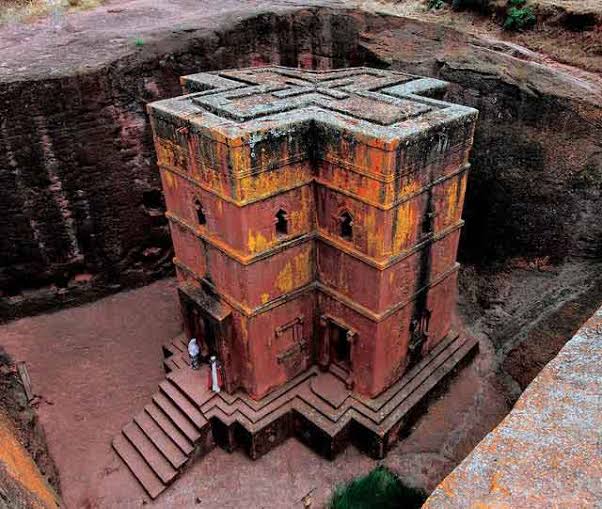
The most famous and extreme example of monolithic church in the world is in Lalibela: the Biete Ghiorgis, which translate to the House of St. George. (hereinafter the St. George Church.) How do you make a monolithic church? The “easy way” is to carve out a church from a huge rock face of a mountainside. Stay on the ground level and just dig in and up along the rock face until you finish the church. This is the construction method used in many monolithic sacred sites such as Petra in Jordan. Here is the more complicated formula use at Lalibela.. First, find a rock mountaintop with a flat summit. From the top, carve out from the mountain a pit 82 feet (25 meters) across and 98 feet (30 meters) deep. Remove all the rock from the outer perimeter areas but leave the central portion untouched. This central portion is now a HUGE rock in the center of the pit you excavated . That center rock is your future church. Carve that center rock down, carve it up and carve out the interior. Keep chiseling until you have formed doors, windows, columns, various floors, roofs etc. At all times you are subtracting rock from the monolithic center block. And don’t forget to dispose of the debris until you have created a rock church 40 feet (14 meters) tall. Here is what your final product will look like:
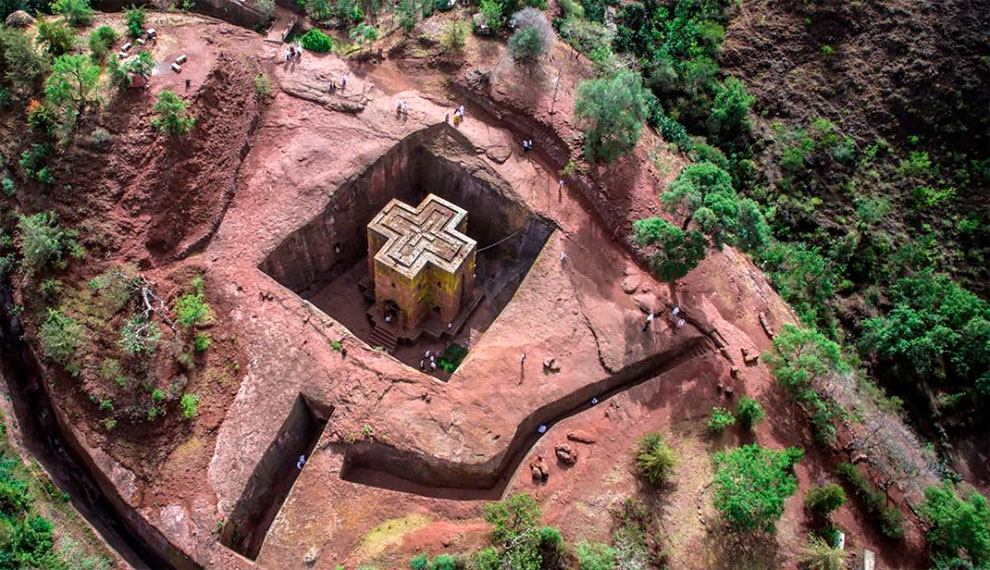
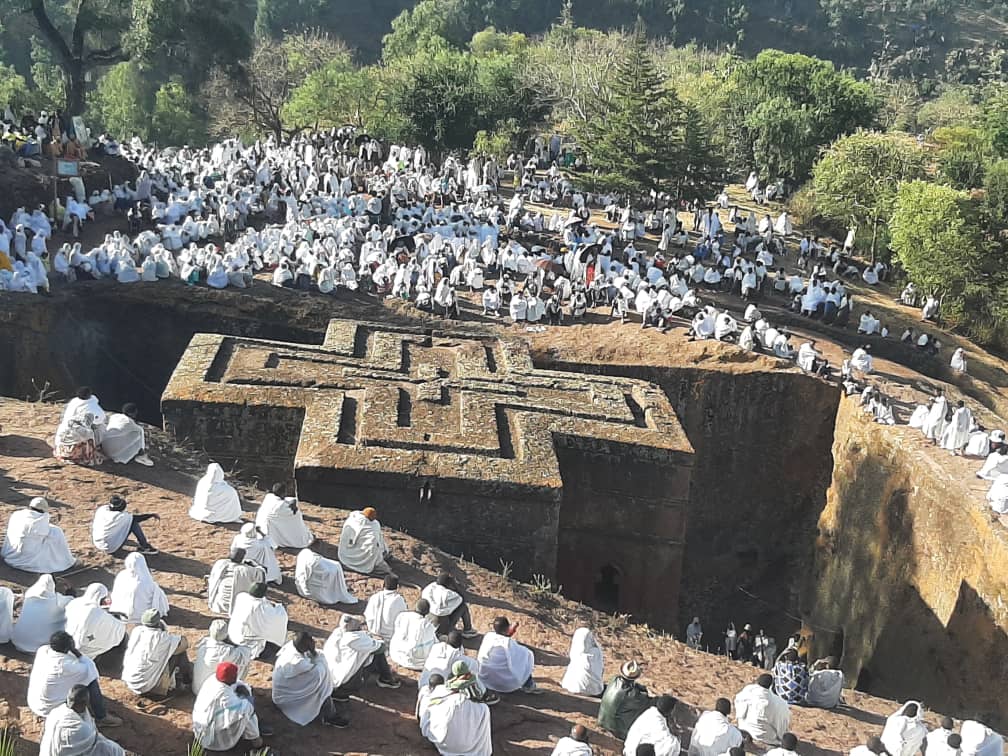
St George Church is just one of the eleven medieval, monolithic cave churches in Lalibela; only four which are free standing like St George Church. Other churches and structures share a common wall with other churches or the adjacent mountainside. The churches were built between 1181 — 1221 A.D. Lalibela is a holiest place of Ethiopian Christianity, still today a place of pilgrimage and devotion.. The churches and related structures are all attributed to the 12th century King Lalibela. The King wanted to create a ‘New Jerusalem’, after Muslim conquests halted Christian pilgrimages to the holy Land. Lalibela is a medieval town that flourished after the decline of the Axum Empire. In Lalibela, there are two groups of churches clustered on either side of a small river.
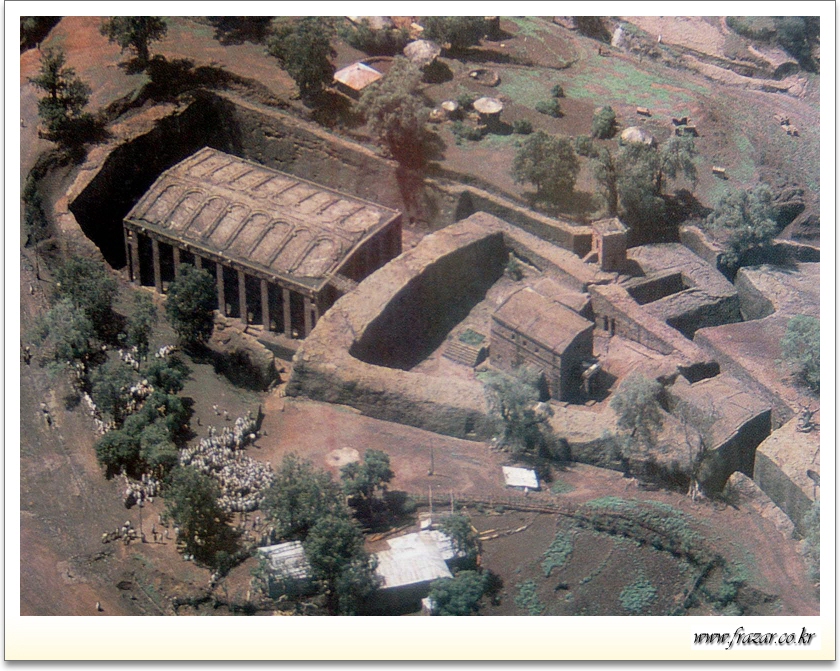
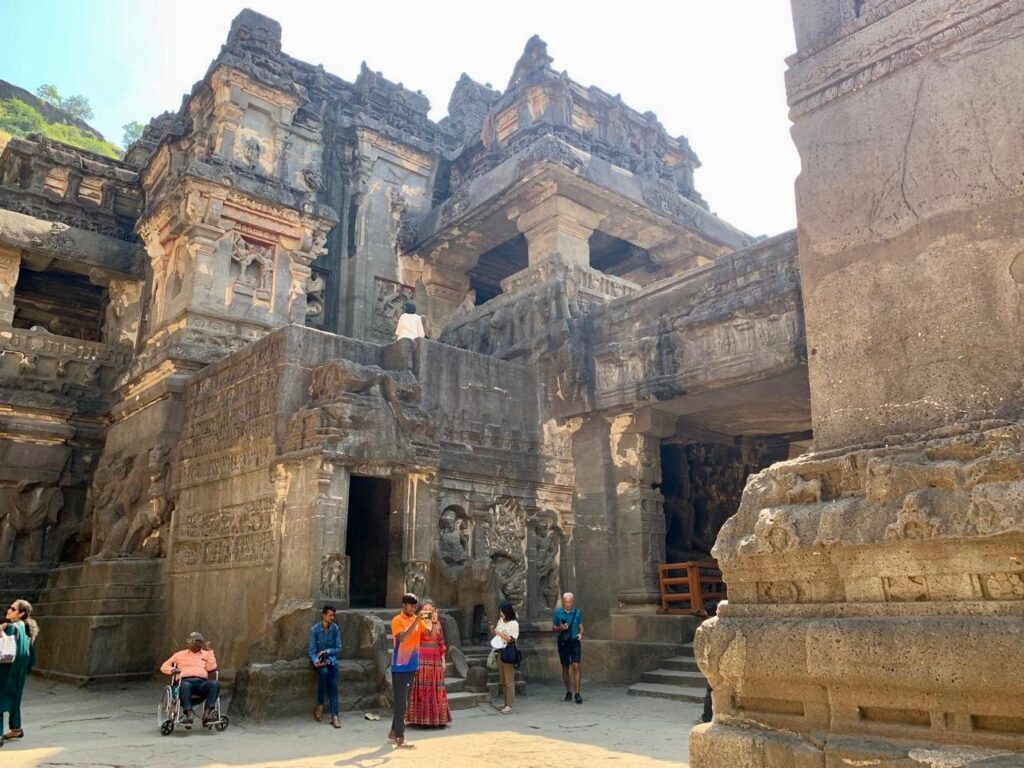
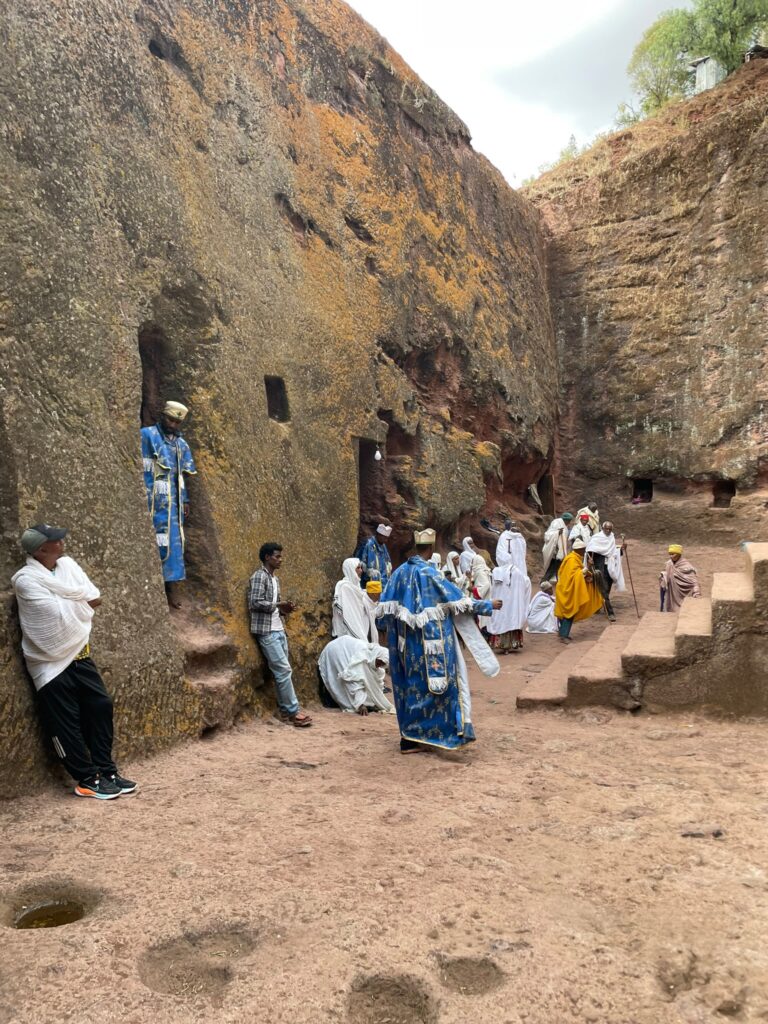
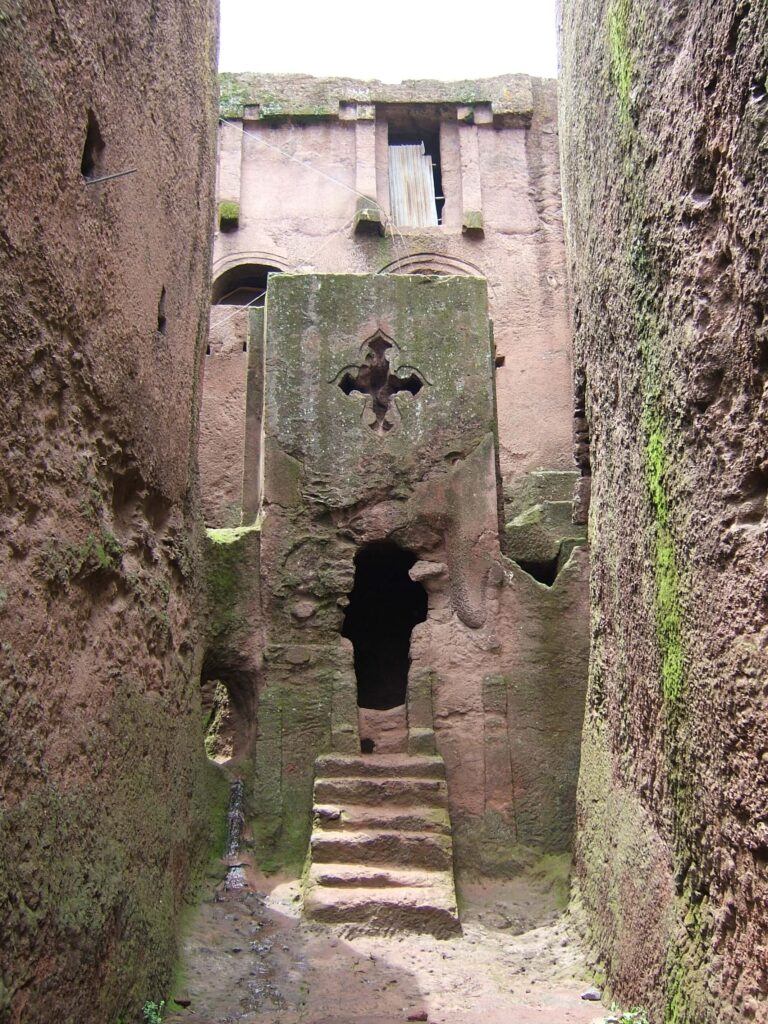
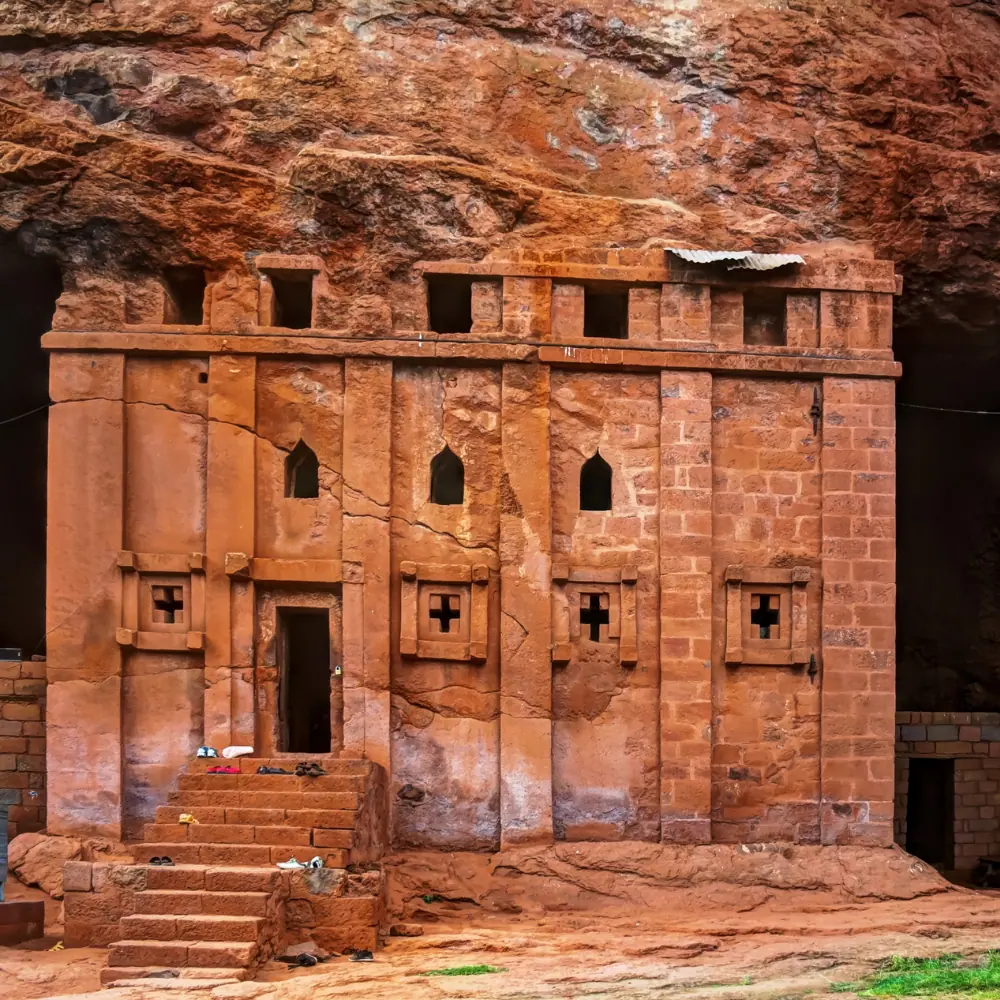
This gigantic inter-connected web of churches was further completed with an extensive system of drainage ditches, trenches and ceremonial passages, some with openings to hermit caves and catacombs. Even the most famous church of St. George, while isolated from the others, is still connected to the others by a system of trenches. Here is a bird’s eye view of the St. George Church:
Travel suggestions by the writer:
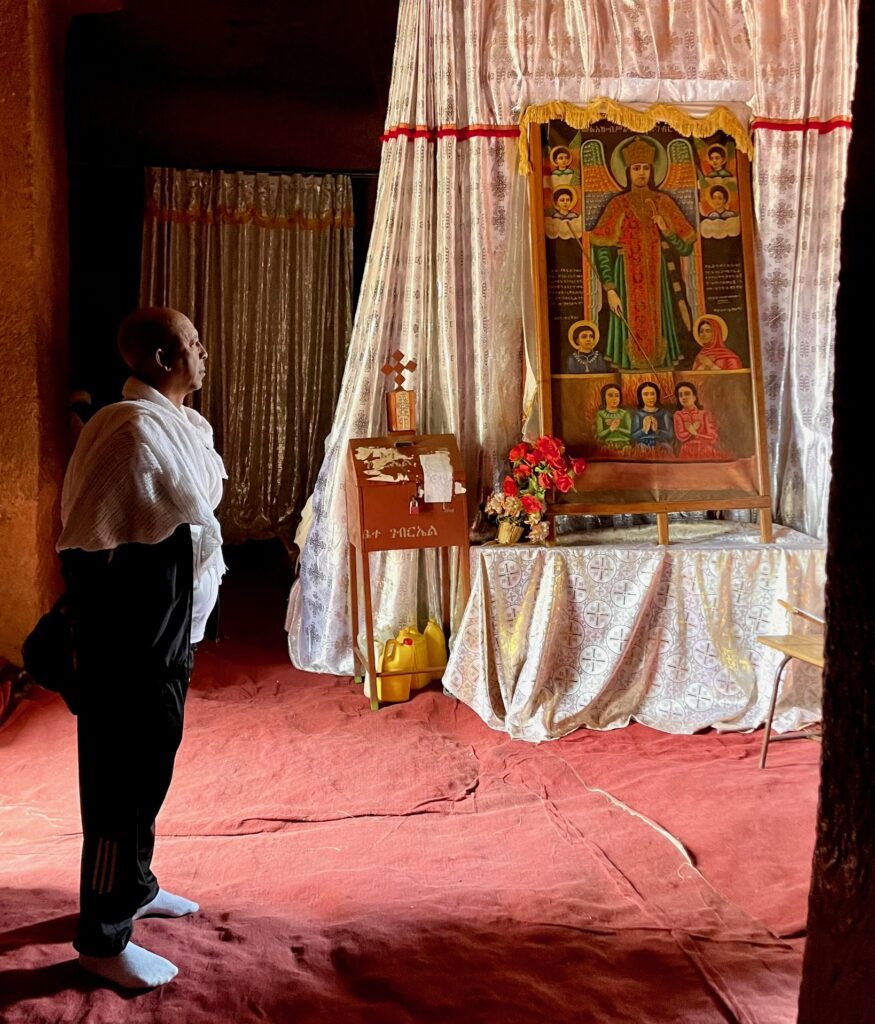
In Laibela land, I used the excellent services of local tour guide, Birhan Fentaw. IF you are in Lalibela and hankerin’ to get an experienced guiding hand, contact Mr. Birhan: +251-911048238 or email: babechfentaw@gmail.com.mobil.
In addition, I stayed at the Top Twelve Hotel adjacent to downtown Lalibela, and recommended it highly:
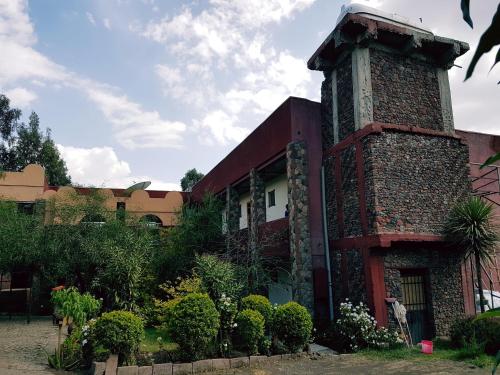
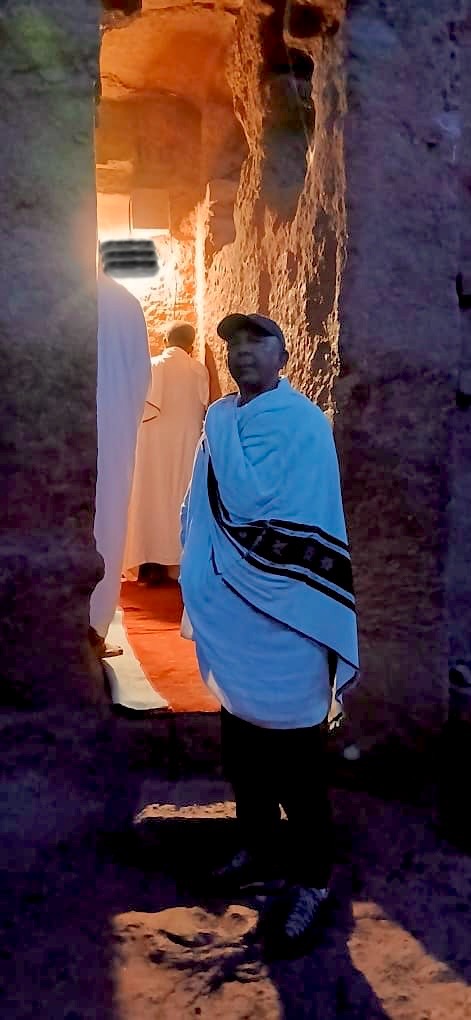
Each room has a balcony with a beautiful view of Lalibela Valley. Above: Top Twelve Hotel. Left and Right: Tour Guide Mr. Birhan Fentaw in the interior areas of one of the many Lalibela churches.
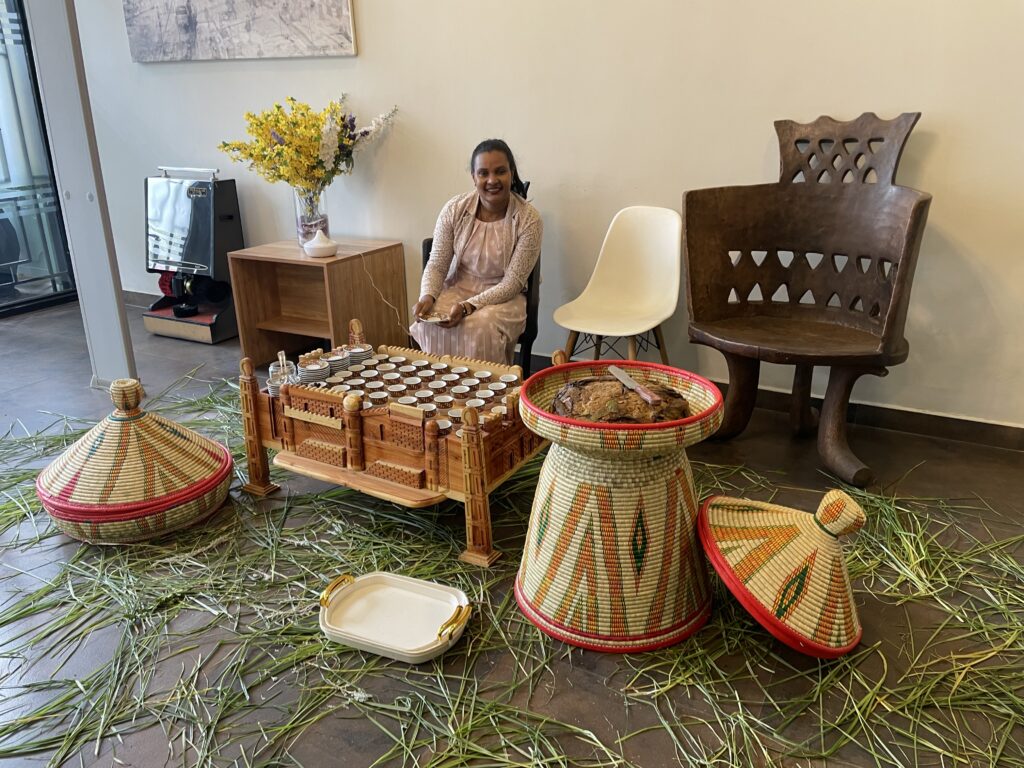
In the capital of Addis Ababa, I stayed at the excellent Addis Ville Hotel Apartment, conveniently located near the airport. The Addis Ville Hotel Apartment hosts a traditional Ethiopian coffee ceremony every Saturday morning for the hotel guests and friends — no charge. This is an excellent way to mingle with guests, both local and foreigners, while savoring Ethiopian coffee culture. Coffee originated in Ethiopia. See addisvilleapartment.com
Axum: The City At the Center of the Abyssinian Empire
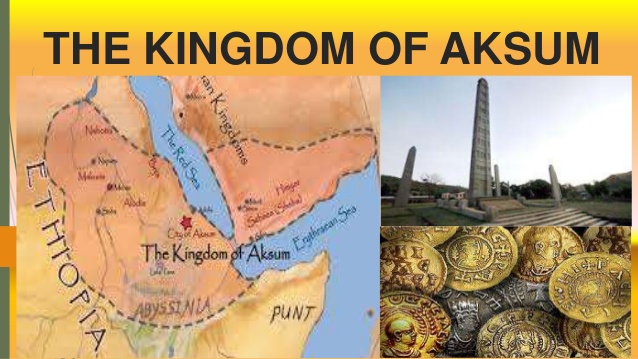
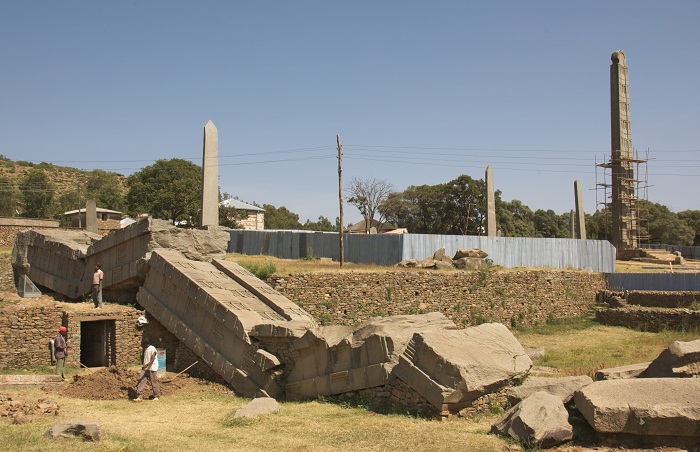
“Axum” is a many splendored thing. The term “Axum” (also spelled “Aksum”) has three different uses. The name “Axum” officially refers to both a city in the Tigray Region of Ethiopia and the ancient Kingdom of Axum, a powerful civilization that flourished from the 1st to 10th centuries CE. Plus, the famous Obelisk of Axum is often referred to as “Axum” as: “Have you seen the Axum yet? It’s really tall!” The city of Axum served as the capital of the Axumite kingdom. Thus, the city has great historic and archaeological significance. This whole area is littered with Axumite monuments and ruins. The most famous monuments are the tall, carved obelisks, relics of the ancient Kingdom of Axum. Most of the tall obelisks are in Axum’s Northern Stelae Park, including the upright very large Obelisk of Axum and an even larger, fallen obelisk, now in pieces. As mentioned earlier, in its heyday, the Axumite Kingdom — and its successor the Abyssinian Empire — were both huge empires. See map above. And both empires followed the Hebraic traditions. Axum Queen Sheba herself was the leading light of this Jewish empire. Menelik I, Sheba’s son by King Solomon took Axum to the apogee (greatest heights) of its success.
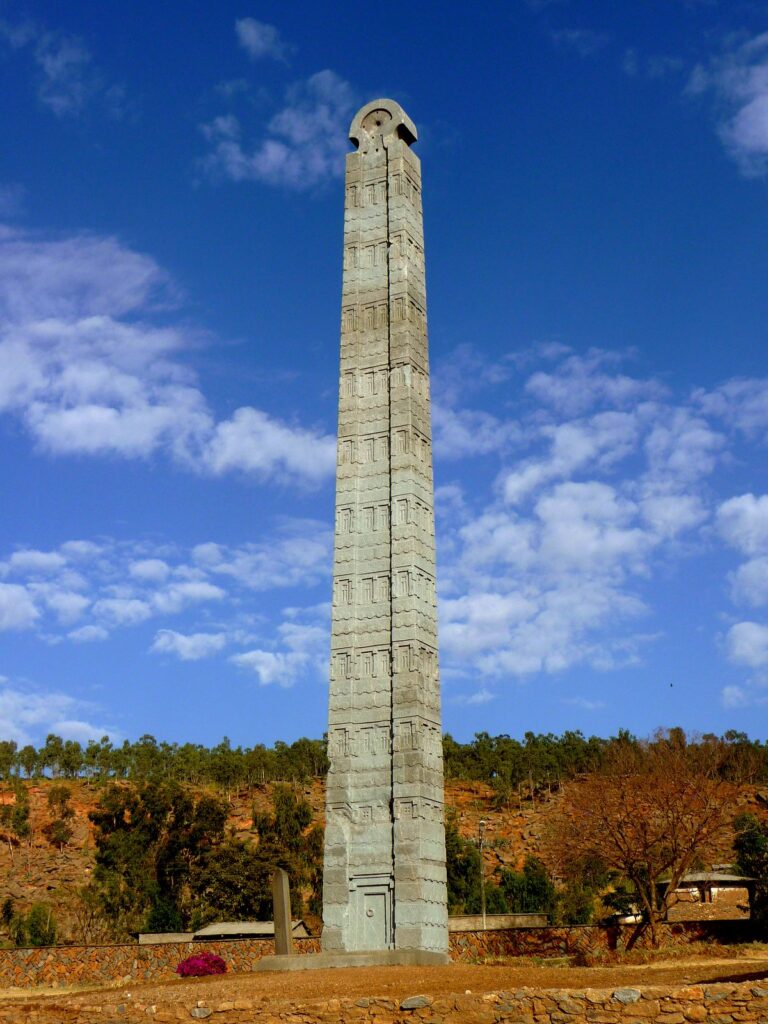
In the Northern Stelae Park is found the famous Obelisk of Axum and many other monumental obelisks, funerary crypts and other sacred structures. “The Obelisk of Axum is a 4th-century A.D. 24-metre (79 ft) tall obelisk, weighing 160 tons It is ornamented with two false doors at the base and features decorations resembling windows on all sides. The obelisk ends in a semi-circular top, which used to be enclosed by metal frames. These obelisks are also called “steles”. Their function is supposed to be as “markers” for underground burial chambers. The largest of the grave markers were for royal burial chambers and were decorated with multi-story false windows and false doors, while lesser nobility would have smaller, less decorated ones. While there are only a few large ones standing, there are hundreds of smaller ones in various “steles fields”. It is still possible to see primitive, roughly carved steles near more elaborate “obelisks”. The last stele erected in Axum was probably the so-called King Ezana’s Stele, in the 4th century AD.” (Taken from Wikipedia)
There are over 300 stelaes in the Axum area. Most of the stelae very small, fallen over, in disrepair or look like grave markers, which is what they are. The large, full throated stelaes are mostly found in the Northern Stelae Park.
The Obelisk of Axum above, is the tallest standing stele in the large and fully populated Obelisk Park at the center of the small city of Axum. Below, you will see just a few of the stele in a small section of the park, including one HUGE obelisk that fell while being hoisted upright. Don’t you think the ancient engineers working on that project had some explaining to do when Axum’s tallest obelisk crashed to the ground?
The St. Mary of Zion Church: The Final Resting Place of the Jewish Ark of the Covenant
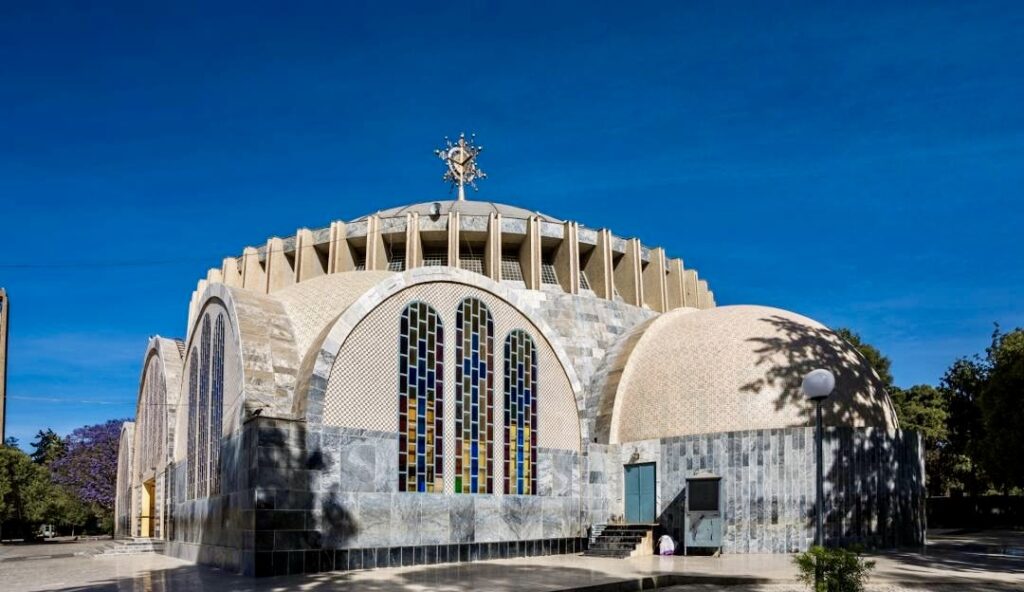
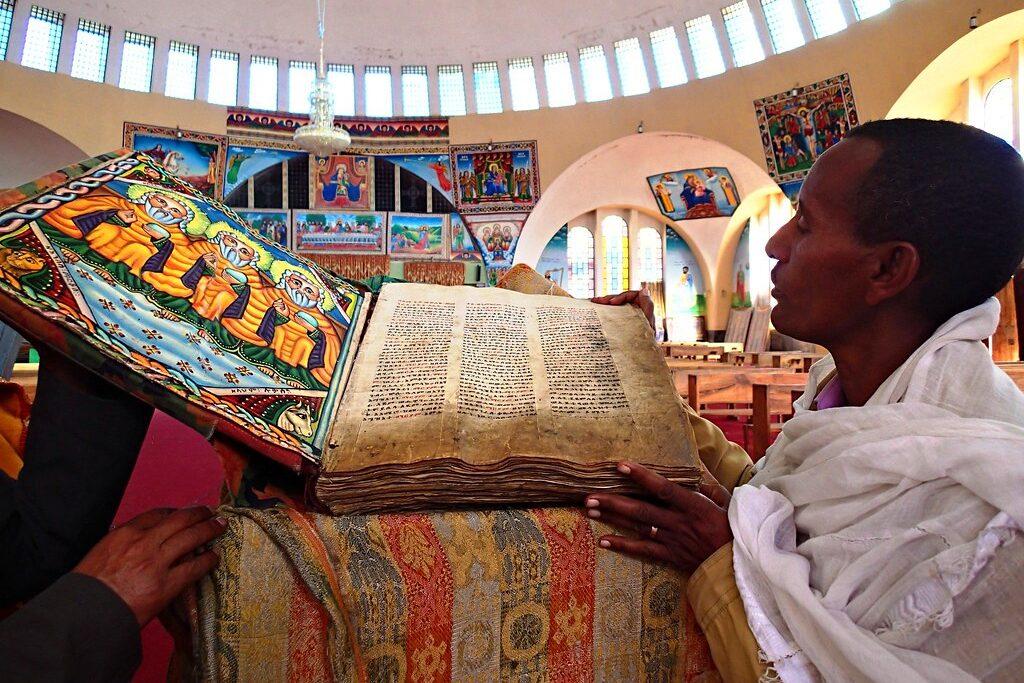
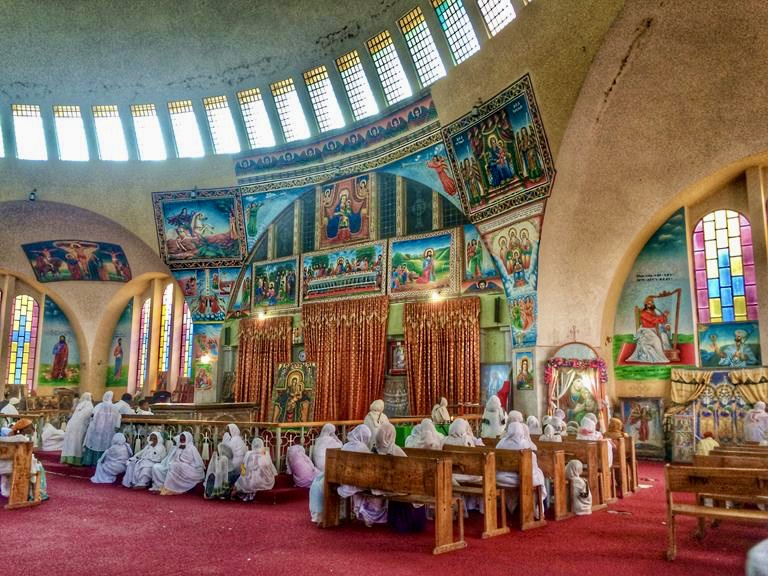
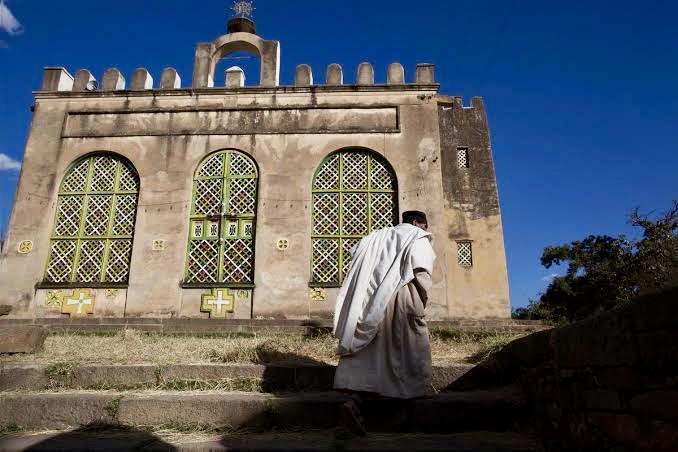
Not far from the Northern Stelae Park in Axum is the famous St. Mary of Zion Church. St. Mary of Zion is a Christian first built in the 4th century A.D. by the Axumite Emperor who converted the entire Axumite Kingdom to Christianity. The church with all of its surrounding sacred sites has been rebuilt and expanded many times. The church and pilgrimage site are believed to have house the biblical Ark of the Covenant. Right next to the church is the Chapel of the Tablet which many say contains the Ark today.
nnnnnn
hhhh
What’s up with the Ark of the Covenant? The Ark of the Covenant was a sacred chest, believed to be made of acacia wood overlaid with gold, that housed the Ten Commandments, Aaron’s rod, and a bowl of manna. It served as a symbol of God’s presence among the Israelites. The Ark was stored in Jerusalem in the First Temple of the Jewish unclear. The Ark disappeared in 586 B.C. and its current whereabouts is unclear
Orthodox Christians believe that the Ark of the Covenant, was brought to Aksum from Jerusalem by Menelik I, the son of the Queen of Sheba and King Solomon. The Ark is believed to be housed in a chapel within the Church of Our Lady Mary of Zion in Axsum. The only person allowed near the chapel and Ark is the caretaker of the temple. The caretaker is a monk who is appointed to this role for life and lives in the chapel in solitude.
Left: The chapel containing the Ark and the solitary caretaker. Is the Ark really in this chapel? I would bet the leaders of the Jews back in Jerusalem may have differing opinions about the location of the Ark.
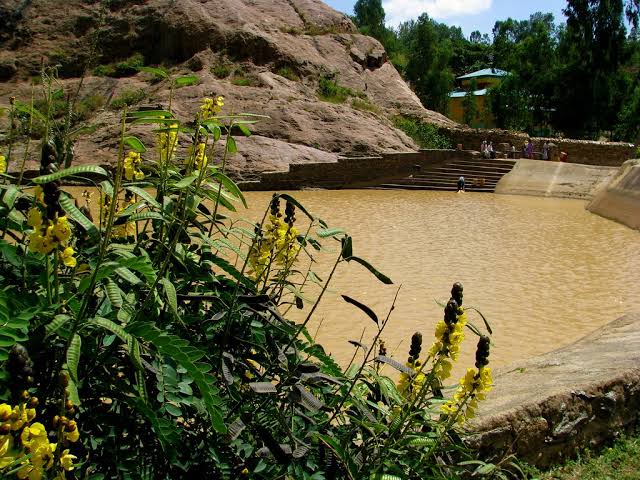
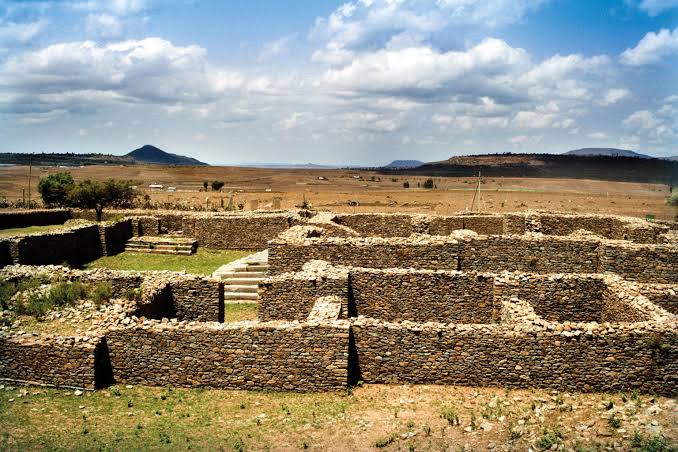
Bonus Photos: As mentioned, history in Ethiopia is not a dead relic found in books. Ethiopian history is alive today. Take Queen Sheba: She is not dead and gone. Well, she is dead but her legacy lives on in the heartland of her vast Empire, right there in Axum City. She is remembered as residents still use the municipal swimming pool she built thousands of years ago. Queen of Sheba’s Bath, with local flora in the foreground, is pictured below on the left. And on the right, is the photo of the remnants of Sheba’s Palace, located right outside of town:
Your magnificent historical photo essay on Ethiopia moved me to get out my Bible and reread chapter 18 of the prophet Isaiah. I read it three times. Yes, it is all there. I have in my Christmas cabinent Balthasar one of the three kings who visited Bethlehem with Frankense. Here in Mexico it’s not so much Santa Claus on December 25 as the THREE KINGS who come on January 6 to fill up children’s shoes with presents while the adults cut a “rosca”. I’ll read it to visitors on January 6, 2026.
Very interesting! Helpful info about travel to Africa and Ethiopia. Thanks for posting!